El Monte
 Log in
Log in
Log in

Thunder Road of Sioux Falls is located in Sioux Falls.
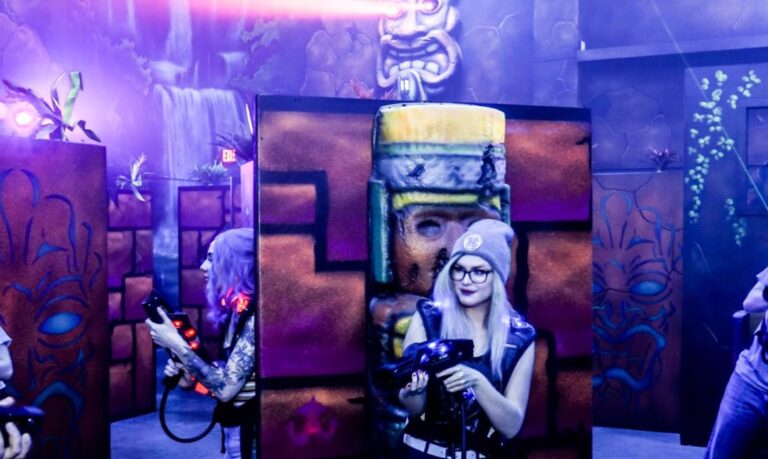
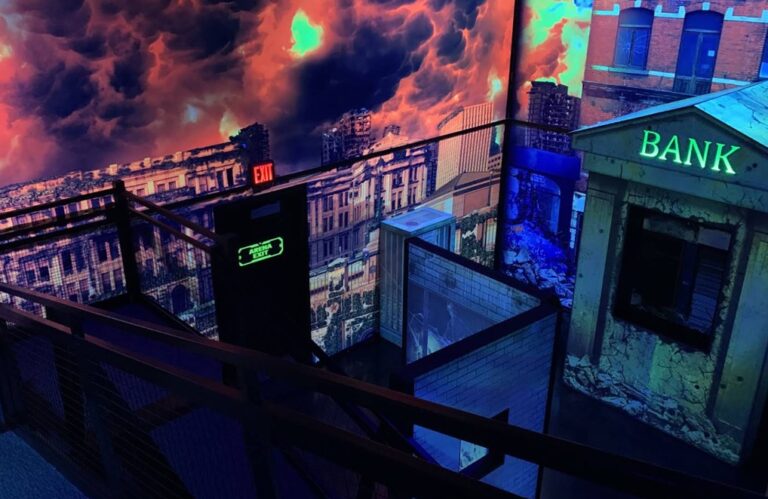
At the core of Thunder Road’s appeal is its state-of-the-art laser tag arena. This multi-level, glow-in-the-dark battlefield transforms players into futuristic warriors navigating a maze of tunnels, ramps, and obstacles. Complementing the adrenaline-pumping laser tag is an expansive virtual reality (VR) gaming zone.
Beyond laser tag and VR, Thunder Road also features a vast arcade floor brimming with classic and contemporary games—ranging from ticket-redemption challenges to racing simulators and motion-based rides.
The facility includes party rooms for celebrations, a full-service snack bar offering everything from popcorn to pizza, and dedicated staff who ensure guests have a smooth and enjoyable experience. Whether hosting a child’s birthday party or organizing a corporate team-building event, Thunder Road provides customizable packages that cater to different group sizes and themes.
 Indoors
VR and Laser tag “Galaxy Gaming” is located in Sioux Falls, SD.
Known for blending cutting-edge entertainment with family-friendly fun, this venue stands out as a hub for immersive gaming experiences. Among its most popular attractions are its high-energy laser tag arenas and state-of-the-art virtual reality (VR) simulations, which together create a dynamic space where nostalgia meets innovation.
What truly sets Galaxy Gaming apart is its commitment to fostering a welcoming atmosphere. The venue prioritizes safety, with clear boundaries and equipment guidelines, while also offering amenities like snack bars, group booking options, and birthday party packages. The blend of traditional laser tag and modern VR appeals to a wide audience, from children celebrating milestones to adults seeking a quick escape from everyday routines.
IndoorsA free‑roam virtual‑reality arena is a specially designed physical space where participants can move unrestricted while wearing immersive head‑mounted displays (HMDs). Unlike seated or tethered setups that limit motion to a small area, free‑roam arenas combine high‑precision tracking, wireless power solutions and safe, obstacle‑free floors to let users walk, duck, jump and even run. The environment is usually padded or cushioned to protect against accidental collisions, and the tracking system – often based on infrared cameras, lidar or inside‑out sensors – continuously maps the user’s position with centimetre‑level accuracy.
The result is a seamless blend of the digital and physical worlds. Players see virtual objects, characters and landscapes superimposed on the real space, while their bodies interact naturally with those elements. Because the arena is a shared, multi‑user venue, several participants can experience the same scenario simultaneously, collaborating or competing in ways that would be impossible in a single‑player home setup.
The versatility of free‑roam technology opens the door to a broad spectrum of scenarios, each tailored to different audiences and objectives.
Adventure Quests – Participants become explorers navigating ancient tombs, alien planets or steampunk cities. The physical layout can be rearranged with modular walls to mimic corridors, chambers or open plains, while the VR engine adds dynamic lighting, puzzles and enemy AI.
Team‑Based Combat – Multiplayer shooters or arena battlers benefit from the added realism of actual movement. Players can flank opponents, take cover behind real‑world props, and experience the tactile feedback of haptic vests or gun controllers.
Training Simulations – Industries such as aviation, emergency response and heavy‑machinery operation use free‑roam arenas to recreate high‑risk situations without endangering trainees. The ability to physically walk through a virtual fire‑hazard zone or cockpit enhances muscle memory and situational awareness.
Social Hangouts – Virtual lounges, concert venues or art galleries allow groups to gather, chat and share experiences. Avatars mirror the users’ gestures, making the interaction feel more authentic than a traditional video call.
Educational Expeditions – Schools can transport students to the surface of Mars, inside a human cell or onto a historic battlefield. The kinesthetic element—walking through a dinosaur‑filled jungle or a molecular lattice—helps solidify abstract concepts.
These scenarios are not mutually exclusive; a single session might blend puzzle‑solving with combat, or education with entertainment, illustrating the platform’s flexibility.
The demographic profile of free‑roam VR users is remarkably diverse, reflecting the technology’s capacity to cater to both casual fun and professional development.
Gaming Enthusiasts – Hardcore gamers are drawn to the physicality that free‑roam adds to familiar genres. The ability to physically dodge projectiles or swing a virtual sword creates a level of immersion that standard console or PC games cannot match.
Families and Children – Parents appreciate the active nature of the experience, which turns screen time into a form of exercise. The environments can be customized for age‑appropriateness, ensuring that younger users encounter content that is safe yet stimulating.
Corporate Teams – Companies use the arenas for team‑building exercises, leadership training and creative brainstorming. The collaborative nature of many scenarios encourages communication, problem‑solving and trust among employees.
Educational Institutions – Schools, universities and museums incorporate free‑roam sessions into curricula to illustrate scientific principles, historical events or artistic techniques. The hands‑on approach aligns with modern pedagogical emphasis on experiential learning.
Researchers and Professionals – Engineers, psychologists, ergonomists and medical practitioners employ the platform for data collection, prototype testing and therapeutic interventions. The precise tracking data gathered during sessions informs studies on human motion, cognition and spatial awareness.
Overall, the appeal lies in the blend of physical activity, social interaction and immersive storytelling, making free‑roam VR a universal medium rather than a niche hobby.
When children engage with free‑roam VR, safety and content curation become paramount. Most venues adopt a layered approach:
Physical Safeguards – Soft flooring, padded walls and clear demarcations prevent injuries. Sensors can automatically pause the experience if a user approaches a boundary too closely.
Age‑Appropriate Content – Software developers create kid‑friendly modes that eliminate violent or frightening elements, focusing instead on discovery, problem‑solving and cooperative play.
Parental Controls – Guardians can set session length limits, monitor usage statistics and select experiences that align with educational goals.
From an educational standpoint, the technology dovetails with several learning objectives. For example, a “Space Explorer” scenario lets children practice basic physics by manipulating gravity fields, while a “Marine Rescue” adventure teaches marine biology through interactive encounters with virtual sea life. The embodied nature of the experience—requiring a child to physically reach, crouch or turn—enhances kinesthetic learning, a method shown to improve retention compared to passive observation.
Moreover, the social component encourages teamwork. Children often need to collaborate to solve puzzles or complete missions, fostering communication skills and empathy. The immersive environment also sparks imagination, providing a sandbox where creativity can flourish without the limitations of physical props.
Event planners have begun to view free‑roam VR as a premium alternative to traditional party entertainment. The technology’s adaptability means it can be tailored to the theme and scale of any gathering.
A birthday celebration can be transformed into a custom adventure. Young attendees might embark on a treasure‑hunt across a virtual pirate island, each clue requiring them to physically navigate the arena and collaborate with friends. The immersive backdrop creates memorable photo‑op moments, and the active nature of the game helps burn off the energy that typically accompanies a group of children.
For graduating classes, a “Future Vision” simulation can let students step into career scenarios—from operating a space station control panel to designing a sustainable city. Such experiences not only celebrate the milestone but also provide a glimpse of professional pathways, reinforcing the transition from education to the workforce.
Corporate gatherings benefit from the blend of entertainment and subtle skill development. A “Corporate Quest” might involve teams racing to assemble a virtual product, solving logistical puzzles that mirror real‑world project management challenges. The competitive yet cooperative format encourages networking across departments, while the novelty factor leaves a lasting impression on attendees.
In each case, the venue can be decorated with real‑world branding, projection mapping or themed props that complement the virtual experience, ensuring cohesion between the physical and digital realms.
The academic and professional communities recognize free‑roam VR as more than a novelty; it is an emerging research tool and a catalyst for innovation.
Scientists leverage the precise motion capture inherent in free‑roam systems to study spatial navigation, memory formation and sensorimotor integration. By manipulating virtual environments while monitoring real‑world movement, researchers can isolate variables that are impossible to control in natural settings. Findings from these studies inform the design of rehabilitation programs for patients recovering from stroke or traumatic brain injury.
Industry experts in HCI evaluate free‑roam arenas as testbeds for new interaction paradigms. The combination of gestural input, haptic feedback and unrestricted locomotion pushes the boundaries of conventional UI design. Prototypes for next‑generation wearable controllers, eye‑tracking interfaces and adaptive soundscapes are often trialed in these spaces before broader market release.
Automotive, aerospace and architectural firms employ free‑roam VR to simulate user experiences within prototypes. Engineers can walk through a virtual car interior, testing ergonomics and control placement without building a physical model. Architects can guide clients through a life‑size virtual walkthrough of a planned building, allowing real‑time adjustments to layout or lighting.
Clinical psychologists explore the therapeutic potential of immersive, movement‑based VR. Exposure therapy for phobias, anxiety reduction through calming virtual environments, and social skills training for individuals on the autism spectrum all benefit from the embodied nature of free‑roam experiences. The ability to control intensity levels and monitor physiological responses makes the platform a valuable adjunct to traditional therapy.
Collectively, these perspectives underline a consensus: free‑roam VR is poised to become a multidisciplinary platform that bridges entertainment, education, research and industry. Its capacity to deliver high fidelity immersion while preserving natural movement sets it apart from static or seated VR systems, opening avenues that were previously speculative.
As hardware costs decline and tracking algorithms become more robust, free‑roam VR arenas are expected to proliferate beyond dedicated venues into modular kits for schools, community centers and corporate campuses. Advances in wireless power transmission and lightweight battery technology will further untether users, extending session duration and reducing downtime.
Content creation tools are also evolving. Low‑code development environments enable non‑programmers to design bespoke scenarios, empowering educators, event organizers and small businesses to craft personalized experiences without hiring specialized studios. Cloud‑based rendering pipelines promise to offload computationally intensive tasks, making high‑resolution, photorealistic worlds accessible even on modest hardware.
The convergence of these trends suggests that free‑roam VR will transition from a niche attraction to an integral component of public and private spaces. Whether guiding a child through a virtual rainforest, helping a surgeon rehearse a complex procedure, or simply providing a thrilling birthday adventure, the technology’s core promise remains the same: to merge the freedom of physical movement with the limitless possibilities of virtual imagination.


 201 North Kiwanis Drive, Sioux Falls 201 SD